
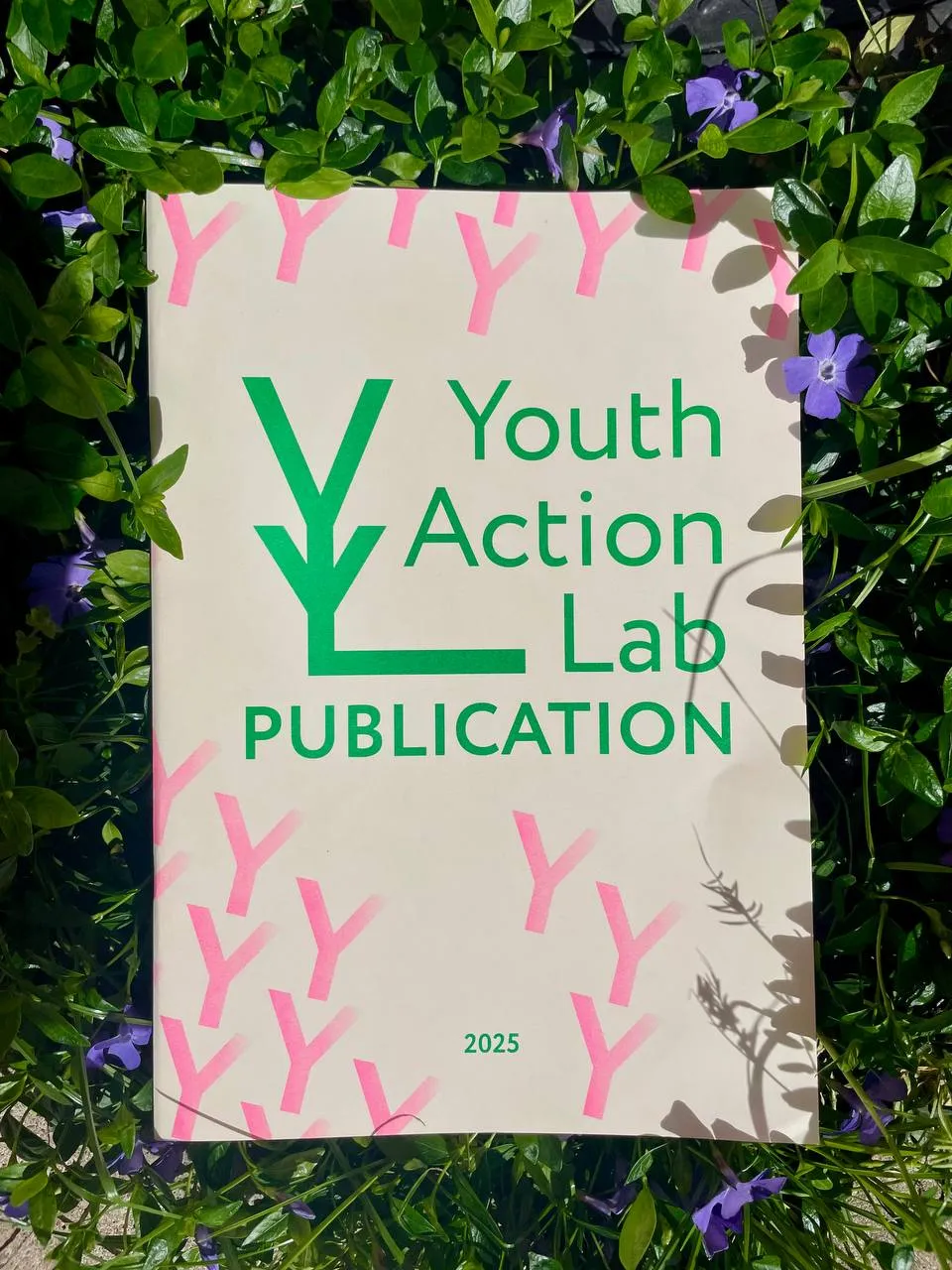
The publication presents nonformal educational and artistic-activist activities of young people from Moldova and Germany engaging in local communities around environmental issues.
Our common starting point was the Moldovan village of Hîrtop in Cimișlia District, where the program was co-shaped with environmental initiatives, activists, and artists. In the former Soviet culture house Casa de Cultura, the two weeks became a hands-on space of exploring creative methods and activist practices, while learning about environmental crises and discussing their sociopolitical dimensions—the program was designed to be engaging and to stay engaged. A community gathering and an exhibition took place at the spaces of Casa Zemstvei, Chișinău.
We hope this publication inspires others—activists, community builders, young people, and trainers—to empower young initiatives to become advocates of sustainable change.
Curators: Luiza Sim and Maksim Polyakov / 3rd Space Studio
Design: Munia Grasen
Project team: Rusanda Alexandru Curcă & Olga Curcă / ArtaAzi
Anna Petukhova & Nadja Sieffert / Coopera
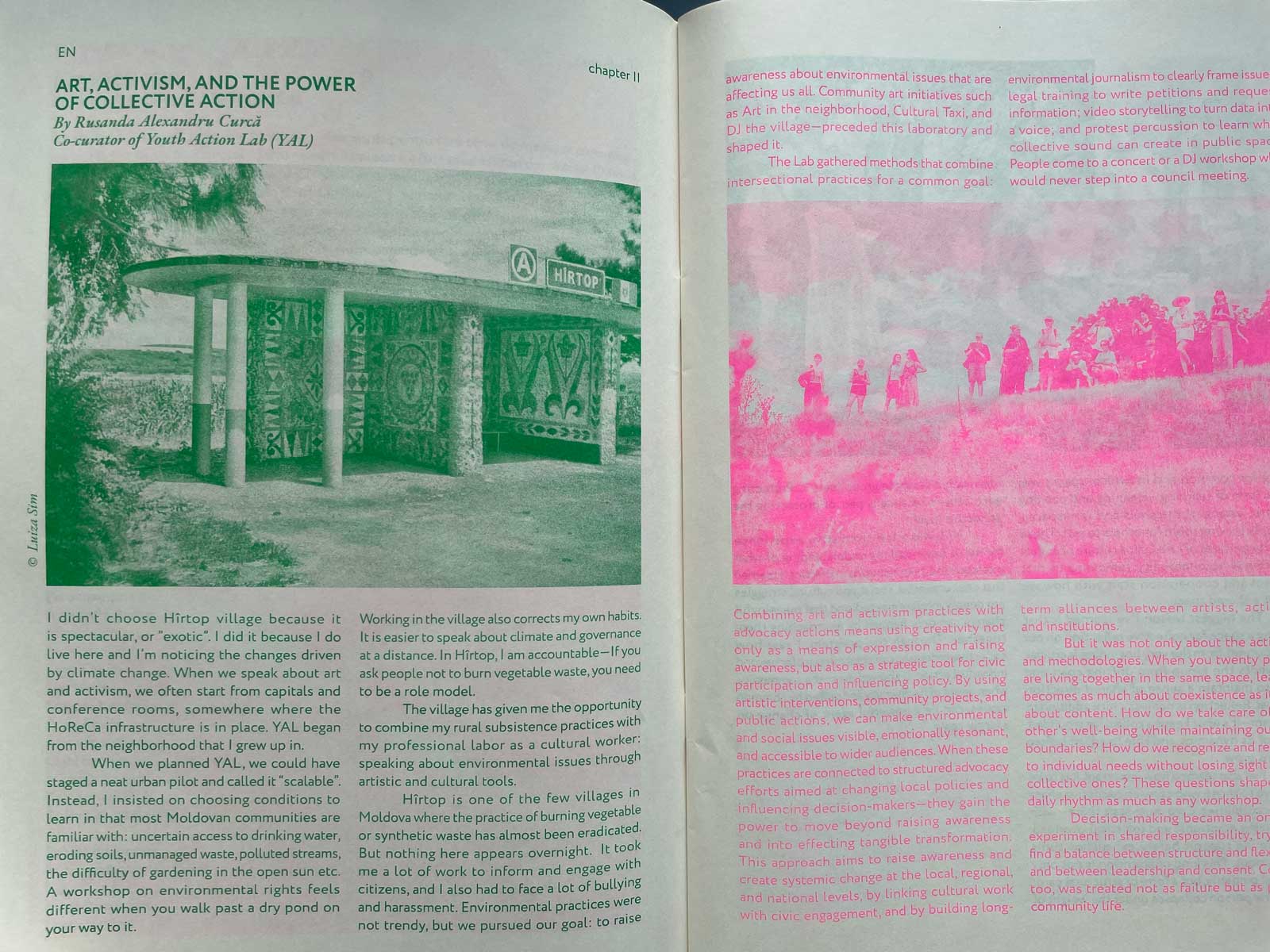
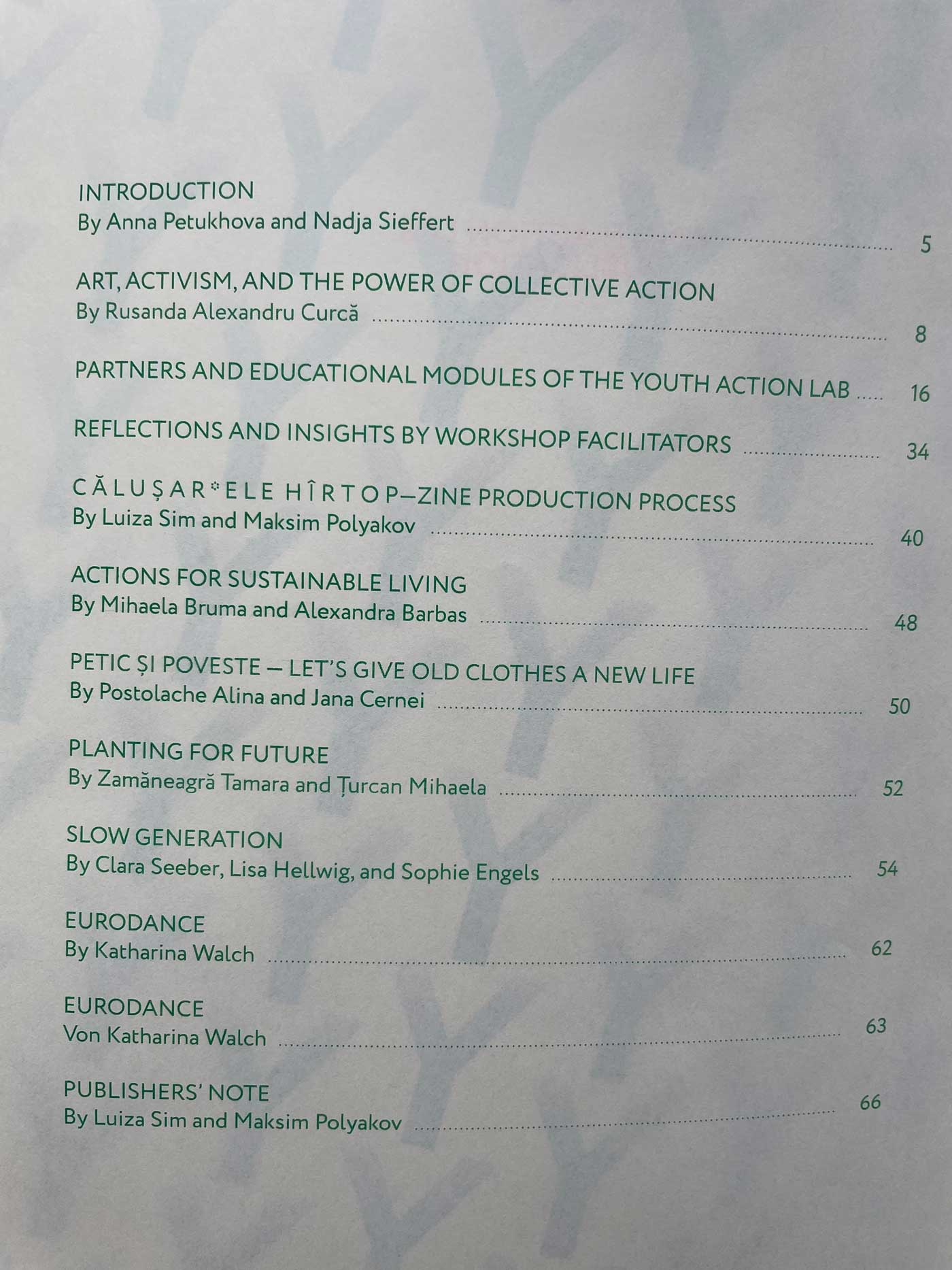
72 pages, 210 x 297, risograph print, printed in Chișinău. Table of contents on the right © Coopera e.V
You can receive the publication for a donation to PayPal. We kindly ask you to at least donate 8€ (for sending inside the EU) or 5€ for pick-up in Berlin.
Please send your address to info@coopera.io.
PUBLISHERS’ NOTE
By Luiza Sim and Maksim Polyakov
We believe in the organising power of the collective mode of production. Even if we are different. With a different motivation. From different contexts and circumstances. From villages or from cities. From Moldova or from Germany. Even if we have unequal levels of responsibility or other inequalities. Even if we form temporary and fragile togetherness.
This can be used as an exercise in looking at how the general mechanism of society functions at a reduced level within small groups.
From the moment of creating any tiny publication, such as a zine or a brochure, we reveal contradictions and perceptions that must be accommodated, confronted, or compromised. Long story short, optimal forms of organisation must be sought. From the point of view of efficiency, any possible forms of organisation become visible not as an abstract, but as a very concrete, material object or process that, in addition to its direct purpose, will manifest as an embodiment of collective effort across time and space.
The publication held in the hands of our dear reader is precisely such an embodiment. With all its strengths and weaknesses, it speaks volumes about itself and about us, its creators.
You can watch the public presentation of our partners & download the PDF here.